

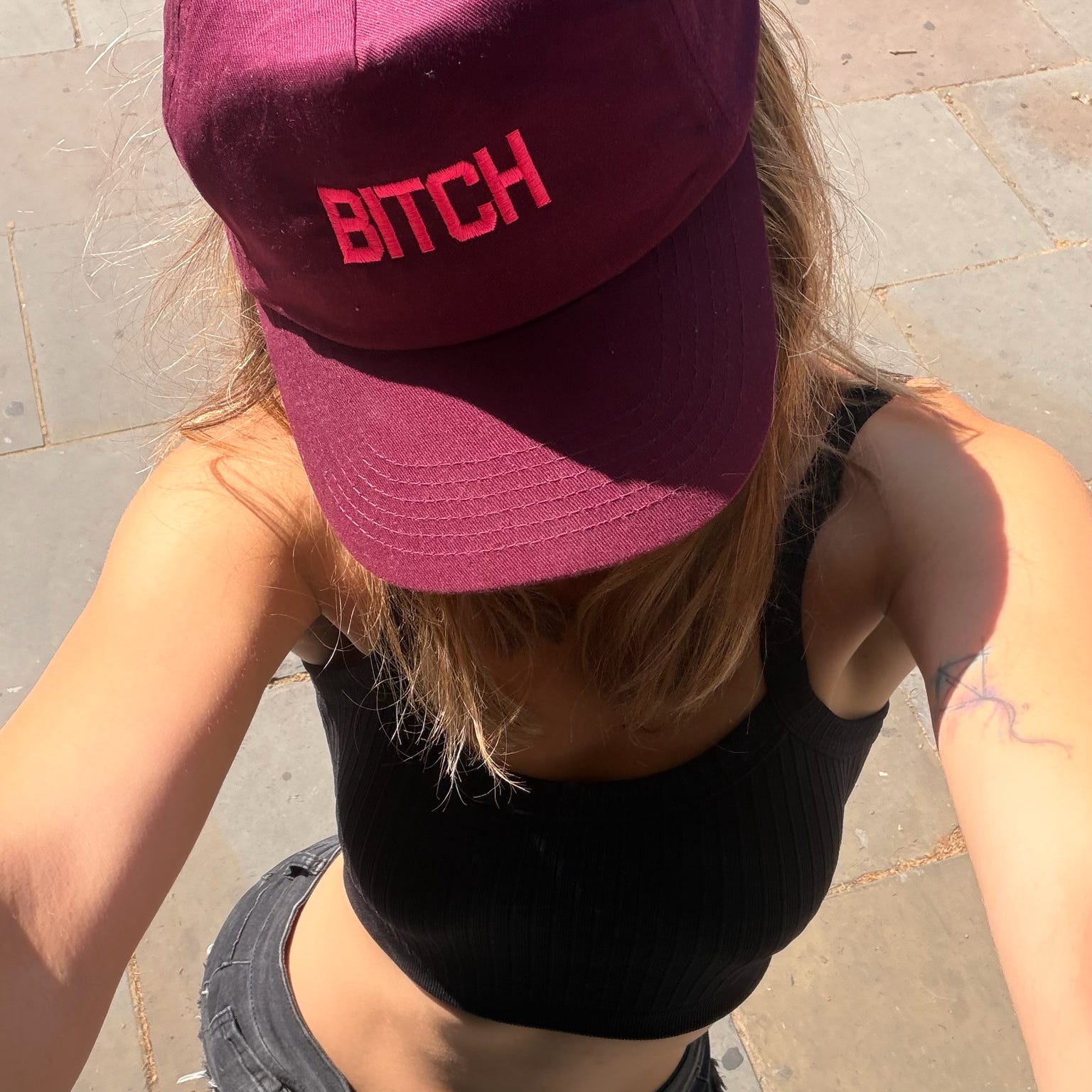
Bitch.
A Character Study. Or, a History of Misunderstanding Myself.

Author’s Note:
I poured a lot of thought into this one.
And I didn’t hold back a single drop of honesty.
What started as a reflection on what it means to be a “bitch” became a story about projection, people-pleasing, identity, and the subtle ways we surrender ourselves in exchange for belonging.
I hope it finds the people who need it.
I don’t think writing changes us.
I think writing reveals what we’ve been trying not to see.
Every essay I publish begins with a question I can’t stop thinking about. Then comes the reading, the psychology, the philosophy, the conversations with myself, and eventually, if I’m lucky, a piece like this.
If my writing speaks to you, becoming a paid subscriber helps me continue creating from a place of depth and truth. It may seem like a small gesture, but it sustains the quiet work behind every word you read here, and maybe something even bigger in the future.
Please help my dreams come true.
Because if I could write all day, every day, I’d do it with joy.

The first time someone called me a bitch, I was in seventh grade.
The summer before, I had my first boyfriend.
For a week.
A week of occasional texts. Never any calls. Going on a date wasn’t possible either because I left my hometown, Mersin, for Istanbul a few days after he asked me to be his girlfriend.
That day, he was going to be at the mall with his friends. He invited me and asked me to bring a friend. Unaware that the friend I brought, Begüm, secretly had a crush on him, I walked with her towards the bowling alley and saw him standing there with his large group of friends.
Adrenaline.
My heart immediately began racing.
Instead of walking over to them, Begüm and I hid our faces and somehow found ourselves sitting on a pile of tyres in the mall’s car park.
I spiralled, convinced I had already ruined everything. Deep down, I didn’t want to be the reason it all fell apart by not turning out to be the cool girl I imagined he was hoping for.
As Begüm and I sat there inventing theories, our attention turned to my phone, its screen lighting up both our faces in the dark car park.
“I’m sorry you had to leave.”
It was him.
Maybe I hadn’t ruined it after all, I thought.
I remember Begüm supervising every message I sent and received, editing my texts and giving herself the final say on what I should reply.
“Will you be my girlfriend?”
After we broke up, Begüm confessed that she had left the mall that day with a tear trailing down her cheek.
Shortly afterwards, we had a fight over something I no longer remember.
Among the many insults she sent me over text, one word appeared more than any other.
Bitch.
I kept questioning what I had done and what being a bitch actually meant.
All I had done was date the boy she liked and disagree with her on things that made her unhappy.
How did that make me a bitch?
What did being a bitch mean?
I wasn’t called a bitch for a long time after that.
The year I graduated from university, I had a boyfriend.
I wasn’t in love with him, but I don’t think I had ever loved anyone the way I loved him. The kind of love where someone else’s smile becomes your greatest reward.
Yet, when the novelty of first love faded, I began to suffocate.
I started leaving myself notes on my phone whenever I felt trapped, so I wouldn’t talk myself out of breaking up with him, since gaslighting my judgement was my second nature.
13 August 2021
You want out of this. The longer you spend with him, the more trapped you feel by what he says and how he acts. Nothing in you wants to meet him halfway.
Yet I kept doubting my judgement.
Way too often.
If I left then, something beautiful would remain untouched while we, in time, accepted that it was time to part ways.
Instead, I stayed while, in truth, I had already left internally months earlier.
I started catching feelings for someone else.
Someone who would later become the one that got away.
Yet I couldn’t break up with my boyfriend without making sure I had enough proof I shouldn’t stay.
I never saw the captain again after telling him that I was in a relationship.
He never called me a bitch.
The disappointment that crossed his face did.
I never got to tell him that I was ready to break up with my boyfriend.
So I didn’t.
Yet if there’s anything worse than heartbreak, it is experiencing it while in a relationship with someone else.
I cheated on my boyfriend later that summer with someone else, and that still remains one of the biggest regrets of my life.
The worst part, though, wasn’t cheating.
It was never telling him.
I knew what betrayal meant to him.
He didn’t know until he unfortunately found out through a friend and called while I was walking to the gym. I picked up the phone casually, and he interrupted me, his voice boiling with anger.
“You are a fucking bitch.”
Beep. Beep. Beep.
Then he blocked me everywhere.
I knew he was devastated.
So was I.
Not because he called me a bitch.
A moment can change your state. It doesn't get to rewrite your character.
But because I knew he would leave believing I had never loved him.
I had.
By the end, though, my love had become something softer, more like the love you have for a best friend. While he stayed because he still believed in our future, I stayed because I hadn’t yet found the courage to leave.
I stood there, in front of the gym, staring at my phone for a while.
I wanted to understand how I was feeling, but whenever I reached for it, all I grasped was emptiness. Part of me felt as though this was the universe’s way of, once again, sealing our break-up by making sure we never got back together.
Shortly afterwards, panic surged.
He blocked me everywhere. It was killing me not to have a way of adding my narrative.
Yet the narrative I wanted to tell wasn’t true.
I wanted to have the chance to rewrite what had happened.
More than convincing him, I wanted to convince myself that he was wrong.
To protect the story I’ve been telling myself.
We didn’t speak for two years after that.
Yet I couldn’t stop wrestling with the undoing of my entire self-story, pierced by a look that silently insisted I was a bad person.
A bitch, maybe.
Later that year, I decided to go to Sri Lanka to teach English to kindergarten students while living with a local family.
I needed distance.
From there and from them.
Most importantly, I needed distance from the person I had begun to believe I was.
So I flew to the other side of the world.
Being away helped.
So did reading The Dispossessed.
It made me wonder whether I had spent years treating identity as though it were a possession.
Something that needed to be defended.
Protected.
Kept intact.
I had become so attached to proving or disproving that I was a bitch that I stopped asking who I was becoming and started obsessing over who I should never become.
Letting go of an identity wasn’t a loss. The less I tried to possess a fixed version of myself, the less I was possessed by everyone else's version of me.
When nothing belonged to me, I belonged to no one.
My worth could never be measured by what I managed to keep, but by what I set in motion; the words I spoke, the hands I held, the traces of care I left behind. Nothingness became spaciousness, a place where change, healing, and new beginnings could enter.
I returned from Sri Lanka more peaceful.
Slowly and quietly, I moved away from living inside the expectations I had built for myself.
I stopped trying to prove I wasn’t the person I feared I had become.
Instead, I slowly let go of a self I had already outgrown.
When I moved to London, no one knew me through the identities I had carried for years.
For the first time, I had the freedom to meet myself before anyone else’s expectations could.
When the version of myself I'd spent years suppressing finally had space to breathe, I realised how often I had mistaken silence for kindness, compliance for love, and self-erasure for virtue.
My life had become hijacked by “musts”, “needs”, and “shoulds”. Society had already given me enough expectations. Somehow, I kept inventing more.
This winter, I felt something unfamiliar surge within.
Or maybe emptying itself.
The emotions I had swallowed didn’t disappear. They became impossible to silence. I became less tolerant of noise, less willing to absorb pressure, and no longer willing to perform emotional labour.
Being responsive became a burden. Messages suffocated me. I delayed replies for months.
It unsettled the people-pleaser in me, yet for the first time, I met myself with compassion instead of criticism.
I was so busy trying to change the way the world saw me that I never thought to change the way I saw myself.
Once I did, other people’s opinions no longer felt like verdicts.
The world never stopped judging me.
Some draped me in admiration. Others wrapped me in suspicion.
Either way, they were responding as much to their own stories as they were to me. I simply stopped treating their judgements as definitions.
After years of searching for evidence before leaving, before believing what I already knew, I met someone who became the final proof that I had stopped waiting for permission to trust myself.
We met through mutual friends, and our conversations came easily.
At first, he seemed nice.
Before long, I thought I’d found a good friend.
I thought he understood me.
Looking back, I realise he had been studying me: my writing, my fears, my ambitions, my wounds.
I mistook attention for care.
Then he told me he was in love with me.
“I love you too,” I said, “but only ever as a friend.”
When reality failed to match the story he had already written in his head, affection turned into rage. Suddenly I was fake. Cruel. A coward. A bigot who should die alone. My appearance became something I had supposedly weaponised against him.
“Your writing sucks, by the way. The only reason anyone reads you is that they have this misconception that you’re attractive or sophisticated,” he wrote in one of many relentless emails that still arrive in my inbox despite blocking him everywhere.
Yet I was no longer interested in proving myself to anyone.
While he kept turning my vulnerabilities into ammunition, using everything I had trusted him with to make me doubt myself, I realised he had never wanted to know me.
He wanted a version of me that belonged to him.
I used to belong to the roles people needed me to be.
My positivity spilt into other people’s lives, feeding them while emptying me.
Until finally, when I emptied everything that wasn't mine, I had room for myself.
For the first time, I felt free.
Free to be anything.
To do anything.
To hold countless possibilities, a love that needs no searching.
When reality didn’t match his illusions, he called me a bitch.
Only then did I realise I’d been asking the wrong question all along.
The question was never whether I was a bitch.
It was why that became the word people reached for whenever I refused to become who they wanted me to be.
The same part of me became something different in everyone else’s story.
To one friend, it looked like jealousy.
To my ex, betrayal.
To someone else, rejection.
None of them were describing me.
They were naming the shape of their own hurt.
The word never described my character.
It described the moment I stepped outside the role they had written for me.
Every story demands a villain.
I’d rather be the villain in someone else’s story than disappear from my own.
Every read, share, and recommendation helps more than you might think.
If you’d like to support me but aren’t in a position to purchase a paid subscription, you can also:
♡ Support me through:
♡ Become a free subscriber and join my community.
♡ Leave a comment and join the conversation
♡ Restack the post if it resonated with you.
If you’re new here, this is probably the best place to start:
About This Space: For Those Who Refuse To Stay Unseen
I write for people who feel deeply and refuse to stay unseen.
https://youtu.be/l3vAVhaIEIk?si=Xfkbs-5YwUJCxLaS
Feel every word of this one. We can be bitches together.